Our wonderful neighbor Jan Seward found this awesome aerial photograph of our neighborhood taken in 1966. You can see the Chief Drive-In Theater in the upper left corner, the field where Highland Mall was soon to be built in the upper right corner, and the old Safeway Grocery in the lower right corner.
Click on the picture to see a very high-resolution version of the photo.
Martha Koock Ward interviewed Mr. Terrell Timmermann about 10 years ago for an article for the neighborhood newsletter. This first-hand account (slightly modified for this blog) is the first-person recollection of life on North Loop in the 1950s and 1960s.
I moved to Austin in July 1945 to attend the University of Texas College of Pharmacy. Austin population at the time was 97,000. U.T. had an enrollment of 8,000 predominantly female (most men were in the service during World War II).
I purchased North Loop pharmacy at 100 East North Loop (recently Hog Wild, and now Vulcan Video) in November 1953 from Morris Austin who had founded it in September 1953. At the time North Loop was a gravel road which connected Airport Boulevard to the Dallas Highway (Lamar Boulevard) and Burnet Road. The other businesses on the north side of North Loop were a hardware store (now Workhorse), a garage by Archie Steaples (now Cash Checking), Bill Wilkinson’s Barber Shop and Clyde Montgomery’s Shoe Repair (now the print shop). Mrs. Schnitzer’s variety store and Betty’s Jewelry (now Forbidden Fruit) and a service station completed the north side of the street.
On the south side of the street across from the pharmacy was Mrs Johnson’s Bakery with a large retail and wholesale business (now old locksmith shop that is for sale). Going east from the bakery was a coin operated laundry (supposedly the first in Texas) and an Ol’ Bossy Dairy Store (milk in returnable gallon jugs) – Later this became Highland Plaza Shoe and Boot Repair and these days is part of Ararat. Next was Tim Gardner’s Arkie’s Hamburgers with benches on the surrounding gravel (presently Ararat). Next was Fred Wong’s grocery (now Room Service). Next was another barber shop and Molly’s Beauty Shop followed by another grocery store (presently the Music Store). Across Avenue F was Glenn’s Service Station (presently the car wash). South of the corner grocery on Avenue F were a wholesale plumbing supply, Jackie’s Beauty Shop and Inez Givens T.V. repair.
The irregularly shaped parcels on both sides of East North Loop in the 100 block were owned by A. F. Smith (father in law of the baker, Howard Johnson) who sub-divided the land into the oddly shaped parcels as they are today (the Smith-Abrahamson Sub-division). A partnership of two house wreckers (Earl Bennett and L. O. (Shorty) Goodwin) built several of the buildings utilizing use materials which were salvaged from the demolition business. Earl and Shorty designed the buildings to fit the irregularly shaped lots, leased the completed buildings and sold them to investors. Mrs. Earl Bennett (Delight) had a lot of input in the building operation stressing affordability for the tenants. Delight designed a small efficiency cottage (she called a honeymoon cottage) to rent for $25.00 a month. Earl and Shorty constructed these with used materials when they were not working on the commercial structures. About 6 of these survive today with long term tenants.
In the late 50s and 60s many changes occurred. I purchased the Fred Wong Grocery building and relocated the pharmacy in 1958. In 1959 I had Shorty build an addition to the building (presently the tattoo shop) for the soda fountain. The soda fountain was a gathering place for the area – a place to drink coffee or soda while you were waiting for a prescription, a car repair by Archie, or a birthday cake decoration from Mrs. Johnson’s bakery. In the afternoon kids stopped in on their way home from school for drinks and a chance to check out the latest comic books. Meanwhile the Ol’ Bossy Dairy Store relocated to the grocery building (Music Store), Tim Gardner enlarged the hamburger stand, the hardware store location became Chestnut Cleaners, Circle K replaced a service station, Johnson’s bakery outgrew their building and relocated on Koenig Lane, Checker Front built a new grocery at Highland Plaza, Dr. Farnsworth opened a medical practice at North Loop and Leralynn, and I decided to retire from pharmacy to concentrate on real estate I had acquired through the years. And finally, but most important to me, my employee, my friend, and my sweetheart, Geraldine, became my wife for life.
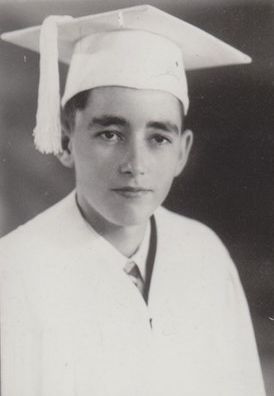
Terrell Timmermann was born in 1929 in Freiheit, Texas (now essentially a part of New Braunfels). After earning a degree in Pharmacy at U.T., Mr. Timmermann served in the Army during the Korean War. He subsequently purchased the pharmacy on North Loop, and became a real estate investor, buying and maintaining scores of properties around the North Loop area. He passed away in September of 2014.
Greg Casar is working hard to stay connected to the people in City Council District 4. Despite a Council Member schedule that burns the candle at both ends and then some, Greg is making every effort to get out into his district as often as possible to stay in close contact with the people who live in North Central Austin.
He is working with his staff to try to hold “office hours” in various locations throughout his district on most Fridays. His busy schedule does not always allow for these community-meeting style office hours, but when he can, he likes to get out and make himself accessible to the people who live in District 4.
In describing the public meetings, Casar says: “I see my in-district office hours as a critical piece of fulfilling the promise of 10-1 government— giving Austinites the power to identify and meet their own needs through their local elected officials. So far, my office hours have been a great tool for giving constituents an opportunity to talk about the issues most important to them at locations all across District 4.”
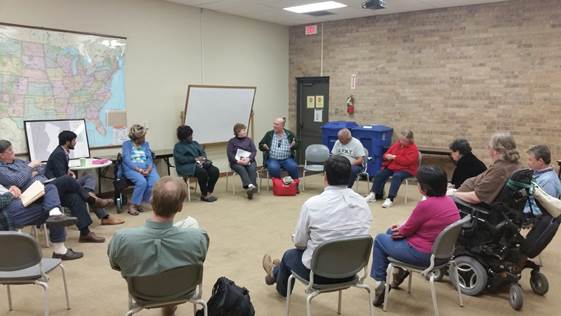
At a recent forum held at Little Walnut Creek Branch Library, many people remarked that they had never seen a Council Member or any city leader come out to meet with residents in that area of Austin — to listen to their concerns and ideas for ways to improve Austin. While people at the meeting occasionally seemed frustrated with trends in Austin or the slow-wheels of bureaucracy, virtually every citizen in attendance gave Casar high praise for coming out and meeting with them to listen to their concerns.
In the future, Casar’s office hours will each be targeted around one policy area, so that constituents interested in that policy area can work together to develop solutions and advocate for change at City Hall. Casar thinks this targeted approach will help his constituency move from identifying problems to implementing solutions. Office hours will be held on a published list of Fridays and Saturdays. Council Member Casar plans to rotate locations to give more residents a chance to visit in an area that is near them.
Casar plans to send out emails, post on social media, and post flyers on bulletins about future times and locations. Casar reports that his next sets of District 4 Office Hours are scheduled to be on March 13th from 1pm to 4pm at a location to be determined. If you’d like to be added to Casar’s email list, you can drop him a line at Greg.Casar@austintexas.gov. You can also follow his Facebook feed: Facebook.com/GregorioCasar.
Council Member Casar, currently a resident of Northfield, also frequently has representation at the Northfield Neighborhood Association meetings (the first Monday of every month at Dayspring Chapel). If he is not able to attend personally, he frequently sends one of his staff members to attend, take notes, and listen to concerns.
Greg Casar isn’t just the youngest Austin Council Member ever elected, he is also arguably one of the most energetic and accessible Council Members Austin has ever known.
I have some good news for fans of good hamburgers. And some bad news for fans of taxidermy. The taxidermy / rug / flag “shoppe” at the corner of Lamar and Old Koenig Road that, for years, has moved the needle quite a bit on Austin’s official Weird Scale has finally closed. Done and dusted — it was torn down just as soon as it was vacated. So if you wanted to buy that vaguely moth-eaten stuffed lion he had on display, you’ll have to go to his new shop on Burnet.
In it’s place will soon rise a new P. Terry’s. This is surely welcome news for most of our neighbors (except the ardent collectors of exotic animal skulls and Union Jack flags), but this must be especially good news for the thousands of state office and DPS employees in the area. Not to mention the students and staff at McCallum High School. Good food served quickly is always welcome around here.
This is a prime spot in a very desirable part of Lamar — Just one more example of rapid investment that will likely change the face of our stretch of Lamar beyond recognition in the near future.
Oh, and while I’m on the topic, it looks like the Omlettery signs are up at their new home on Airport Boulevard, and if I’m any judge, they should be open soon.
Ditto the new Sala and Betty restaurant next to House Pizza. I haven’t been over there in a few weeks, but they looked like they were ready to open. Anybody tried it?
The lots on the eastern side of our neighborhood were originally platted before the popularity of the automobile redefined suburban sprawl. This was the ‘20s and ‘30s, and back then, before the invention of the 2-car garage, home lots were very small — typically just 25 feet wide. At that time, people usually walked more than they drove, and pedestrian-friendly row-houses were much more common and popular.
However, in the ‘30s and ‘40s when people actually started buying and building on these lots in our neighborhood, land in our area was remarkably cheap, and the automobile was changing our lifestyle habits. One lot could be purchased for just a few hundred dollars, and so most people who were buying lots in our neighborhood would buy 2 or 3 contiguous lots, and they would build one house with a large yard across those lots.
However, legally, they were — and are still — individual lots 25-feet wide. Today, when people buy a house on the east side of our neighborhood, what they are actually buying is one house that sits on 2 or 3 lots. And legally, they could tear down the one existing house, and rebuild 2 or 3 houses on the original 25-foot lots.
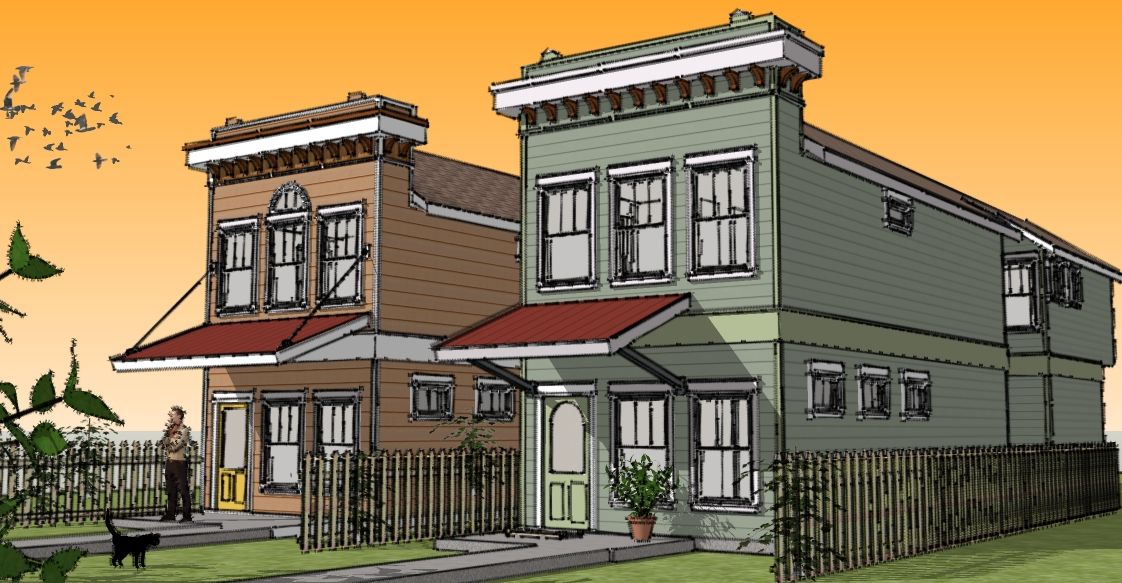
Now granted, a 25-foot wide lot is very hard to build on with current building codes. For example, with 5-foot setback requirements on each side, the house can only be 15-feet wide. However, as the dirt under our houses becomes far more precious than the houses themselves, at least one builder is experimenting with this model of new-home construction. In recent years, David Whitworth has been buying some of these lots, removing the existing house (he prefers to relocate the old house rather than tear it down and toss it in a land-fill), and building 2 or 3 very narrow houses on the original platted lots.
Whitworth is currently building two new homes directly behind Drink.Well that will feature parapet roofs and metal awnings. These homes will be designed to mimic the “classic main street” feel of the North Loop Strip.
Some of his motivation for this type of development is to recreate the pedestrian-friendly, tight-knit neighborhoods that were developed before the popularity of the automobile. In his opinion, it is a “greener” and more sustainable lifestyle. But Whitworth also believes that this is a more affordable model for families wanting new-construction homes in Central Austin.
These days, a typical new-construction house built on a 50-foot wide lot in our neighborhood can be sold for over $600,000. With a smaller lot, Whitworth is able to sell his houses for considerably less.
So how is this different from a “Stealth Dorm?” Until we convinced the city council to reduce occupancy limits to 4 unrelated adults on single-family lots, our neighborhood was inundated with scores of Stealth Dorms – housing designed from the ground up to be rental units for unrelated people. Some people have expressed concerned that Whitworth’s small houses have all the same problems as Stealth Dorms – many people living on a plot of land that formerly housed few people.
Certainly the problem with Stealth Dorms is that they invite very transient housing — bad neighbors who are not invested in the neighborhood. Stealth Dorms invite loud parties, rampant reckless driving, over-flowing trash cans, and other problems too numerous to list. But the worst part of Stealth Dorms is that they will never be occupied by families. Stealth Dorms are designed with a single purpose – they are built from the ground-up as multi-family rental properties with only the veneer of a single-family home. The design and lay-out of the Stealth Dorm structures are simply unsuitable for single-family use, so they will never be anything but Stealth Dorms.
That is very different from a house designed for family living that happens to be rented out to other people. A house that is designed and built for family dwelling may temporarily be rented to unrelated tenants, but it always has the potential to be a single-family home.
So far, most of Whitworth’s houses have been purchased by owner-occupants, but even if they were rented out temporarily, they seem to have few of the same problems that Stealth Dorms have. So far, these seem to be very family-oriented, and the people living there do not have the same undesirable tendencies as the people who are attracted to the Stealth Dorm lifestyle.
Of course Whitworth seems to be a man of great integrity who cares deeply about sustainable building and has deep roots in our neighborhood. His houses may be reasonable and well-designed, but what if other developers begin building less neighborhood-friendly homes like this?
That may be possible, but it seems unlikely. As long as the city council does not try to increase occupancy limits again, there is little incentive to build Stealth Dorms any more. New construction is trending toward single-family housing in the core of the neighborhood and multi-family housing on the transit corridors. And most builders seem to be disinclined to take a chance on building 15-foot-wide homes. For now at least, Whitworth seems to be the only developer interested in pursuing this model of development, and as long as it is Whitworth doing it, it is probably going to be good for our neighborhood.
In the early years of the operation of the Texas Lunatic and Insane Asylums in the 1850s, when patients of the Asylums died and nobody collected their remains, they were buried near the entrance to the grounds (near what is now 41st Street and Guadalupe). By the 1880s this became problematic for Asylum expansion, and so a new site for a cemetery on the northern edge of the Asylums was identified. The remains from the old cemetery were exhumed and moved to the new, much larger site. (Originally, the Asylum grounds were a very large and sprawling complex of 1,000 acres that included a large pond, a dairy farm (now the Intramural Fields), and a hog farm (now the Triangle).)
However, over time, even the new 11-acre cemetery site became quite crowded. Most people who died in the Asylums were claimed by their families and loved ones for a proper funeral elsewhere, but when somebody was not claimed, they ended up at the cemetery on the north edge of the Asylum grounds. Additionally, unclaimed remains of residents of the Austin State School (a state residential facility for the mentally handicapped) have been buried at the cemetery in recent years. All told, over the course of 100+ years, approximately 2,900 people have been buried there. About 700 of them are completely unknown – records of their names and the locations of their graves have been lost. Most of the graves that are marked are only marked with an identification number in a stone slab, usually just under the surface. The only tombstones in the cemetery were ones provided by families or loved-ones, often years later.
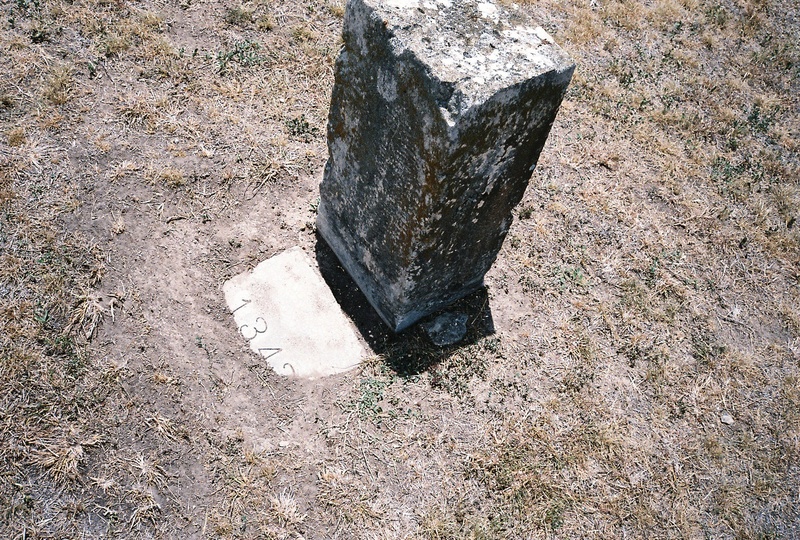
Tombstones in the ASH Cemetery like the one above are rare. Most of the nearly 3,000 people buried there only have ID numbers marking their graves.
Until quite recently, autopsies were regularly performed at the Asylums and State Hospital, including U.T. Tower shooter Charles Whitman. The human “byproducts and waste” generated by those autopsies were buried at the cemetery. One full row of the cemetery was dedicated to the disposal of body parts, but after a flood of Waller Creek washed many of those remains downstream, an incinerator was built in the 1990s to dispose of medical waste.
As one would expect, the cemetery is largely racially segregated. Until the 1960s, blacks were segregated even in death, and there is a wide, largely unoccupied swath down the middle of the cemetery separating the blacks from the whites.
By the 1970s, the whole “flightpath” zone around North Loop was falling into neglect, and many of the city’s homeless and delinquents found that the cemetery was a quiet place where they could camp and engage in illicit activities without being disturbed. Rumors of late-night Satanic rituals in the cemetery (probably untrue) began upsetting people, and both the city and state decided to intervene. A more secure fence was built, and police began to regular patrol the cemetery. Visitors to the cemetery were strongly discouraged, and the grounds were cleared of vegetation to make it easier to see when people are trespassing.
With the new century came renewed interest in the cemetery. The internet gave rise to a widespread interest in genealogy; people began tracing their ancestral roots, and found that some of them ended in a state institution. Mueller Airport closed, and planes stopped skimming over the roofs of Northfield. New people moved to the neighborhood, and visitors to Epoch Coffee often cast their gaze to the east and wondered about the grim cemetery – apparently neglected.
This interest was fueled by historical notoriety that came to the cemetery about the same time. For many years, people had known that John Neely Bryan (founder of the City of Dallas and Postmaster for the Republic of Texas) had been buried at the State Hospital Cemetery, but it was unclear exactly where he was buried. While many people of his public stature would have been buried at the Texas State Cemetery, Bryan had suffered from alcoholism and dementia late in his life, and was sent to the Lunatic Asylum in 1877. He died the same year, and despite his notoriety, his remains were unclaimed, so he was buried near the entrance at 41st Street and Guadalupe.
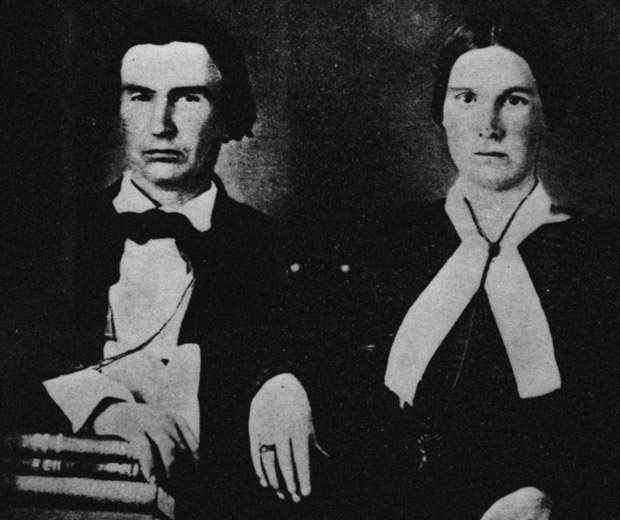
Founder of Dallas, Postmaster for The Republic of Texas John Neely Bryan and his wife.
When his remains were exhumed and moved in the 1880s, no records were kept to identify individual remains. Approximately 50 graves were moved to the new site, and supposedly wooden markers were placed to identify individual sites. However, if those wooden markers ever existed, they rotted away. The only remaining marker was a stone pillar placed at the end of the row of moved graves.
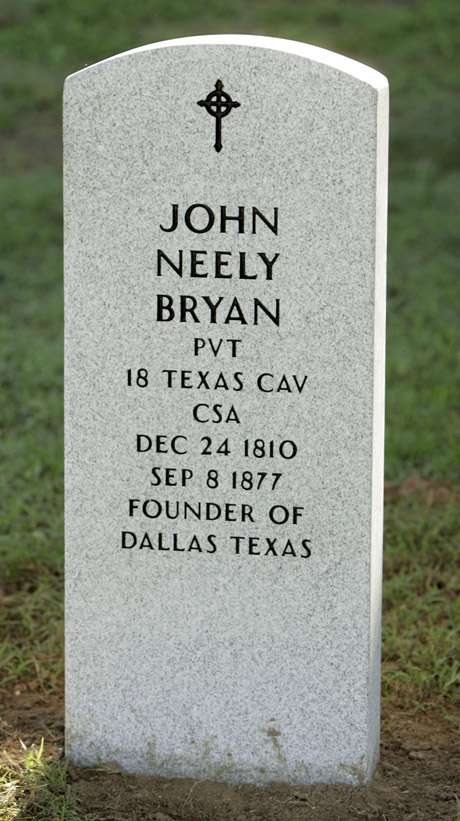
Extensive research into the precise location of Bryan’s grave was fruitless – records from that period were sketchy at best. Finally, in 2006, Bryan’s descendants decided to just pick a grave and place a marker to commemorate his remarkable and colorful life. (So there is a 2% chance the marker actually does mark his gravesite.)
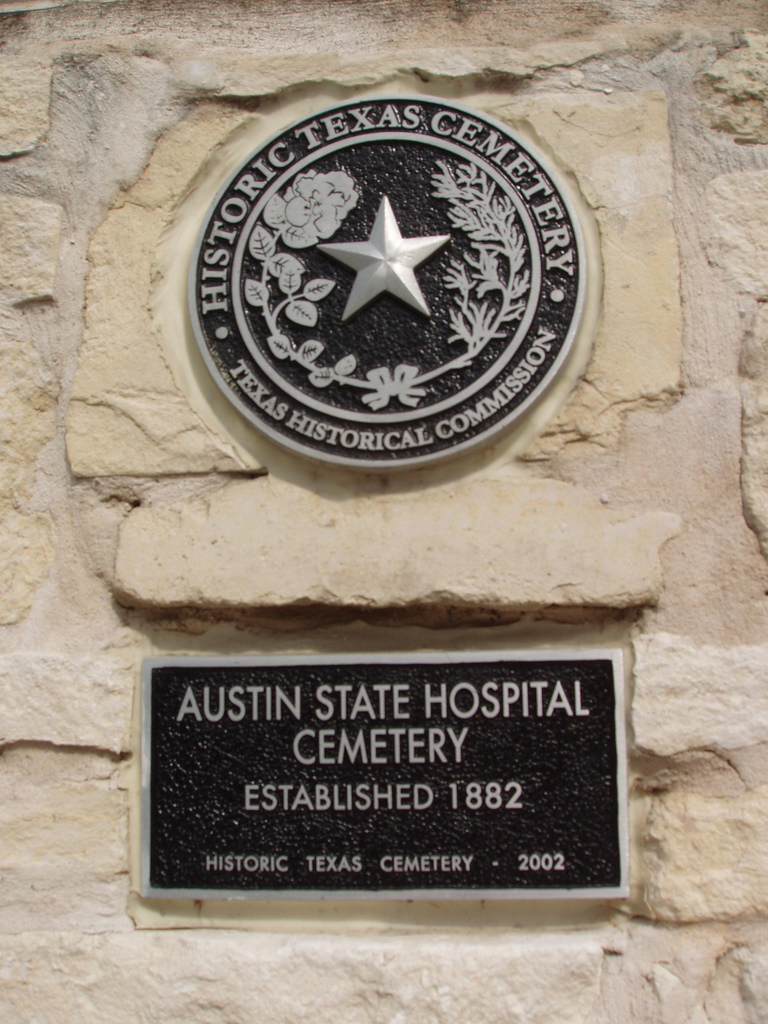
The recent attention to the cemetery and the interest in the stories of the people buried there has led to an effort by the Austin State Hospital to improve both the records and the grounds. In 2002, the cemetery was designated an “Historic Texas Cemetery,” and before the recent economic crisis, a revitalization effort was started to substantially improve the grounds.
Shortly before he died in 2010, Charles McCarthy, a former patient of the State Hospital, hand-welded and donated a new main gate to serve as a grand entrance to the revitalized grounds. A driveway was paved, and construction began on a limestone and iron fence along the south border (along 51st Street). However, the economic crisis brought all of the renovation work to a halt. The unfinished limestone pillars began to crumble and fall.
Now that the economic crisis is coming to an end, hopefully there will once again be interest in fixing up this long neglected cemetery. Maybe it could be a public place with a promenade down the middle of the cemetery (that swath of unoccupied land separating the whites from the blacks). Maybe proper markers could be installed to better describe the lives of the people who are buried there. Or maybe it will continue in its current condition, fenced off and forgotten. (That is, after all, what happens when nobody does anything.)
The cemetery is a relic of history much older than our neighborhood. It long predates everything standing around it, and as an historical site, it deserves our deep respect. Like the Austin State Hospital itself, it has lived for decades on the edge of ruin – a crumbling and neglected artifact of an ancient Austin that is almost impossible to imagine any more.
When people describe what they love about Northfield, typically they say that they love its eclectic atmosphere, convenient location, quaint houses, and awesome neighbors. And usually people specifically say that they love being able to walk to a variety of shops, restaurants, and interesting destinations.
Everybody loves the wide variety of destinations in the neighborhood, but nobody likes living next to a bad neighbor. Sometimes when an innovative, new business opens in the neighborhood, they create problems for the quality of life enjoyed by nearby neighbors.
We love the cool restaurant or bar nearby, but we’re not wild about all the cars circling around looking for free parking on our streets. We love the new coffee shop, but we’re not at all happy to be awakened in the middle of the night by noise generated by the coffee shop.
And we love the idea of food trailers — they’re cool, hip, and edgy — but there are problems that come along with having them near people’s homes. A lot of us loved the “food trailer park” at the corner of Martin and 53rd, but living nearby was no treat. While we all enjoyed an occasional Red Rabbit doughnut, nearby neighbors put up with daily trash in their yards, noise at odd hours, and a nasty rodent infestation. And don’t forget the smell — nothing beats the smell of baked goods mixed with outdoor chemical toilets.
MMMmmm — Chemical doughnuts….
The food trailer park at Martin and 53rd is gone now, but the idea of a food trailer park still remains. A new food trailer is trying a similar model at Bruning and Evans. The Feedlot (“Austin’s newest food park!”) has fenced in the lot around the Snappy Mart, installed a large outdoor seating area, and parked their trailer inside. They have invested a good deal of money fixing up the lot, putting in covered seating, and preparing for their grand opening (any day now).
This sounds quaint, but it may not be a great treat for nearby neighbors. The Feedlot website is advertising their plans for live music and late hours. And that may not be music to the ears (ahem) for people who are living and raising their children nearby.
When Epoch Coffee first opened, many people were excited about having a 24 hour coffee shop in the neighborhood, but people who lived nearby soon discovered that there is a down-side. People listening to music and laughing and having fun out on the deck at Epoch at 3:00 in the morning are just bad neighbors.
After a little complaining, Epoch tried to be better neighbors — they turned down the speakers out on the deck, and asked their patrons to be mindful of their noise. It’s not perfect, but at least they tried, and I think most people would now say that Epoch is a valuable addition to our neighborhood.
Finding the balance between cool and annoying isn’t always easy. A new restaurant opening in the neighborhood is exciting, and hopefully they have great food we can all enjoy. But let us also encourage our new neighbors to be mindful of those around them — Let’s be clear about our expectations that they keep the area clean, and keep the noise down.
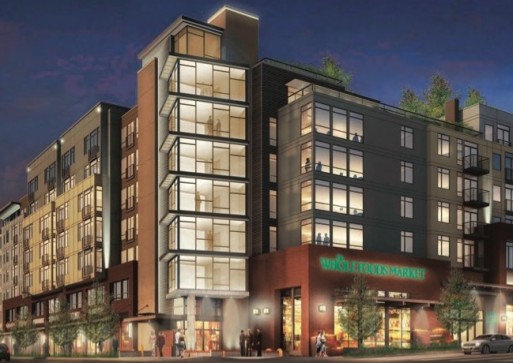
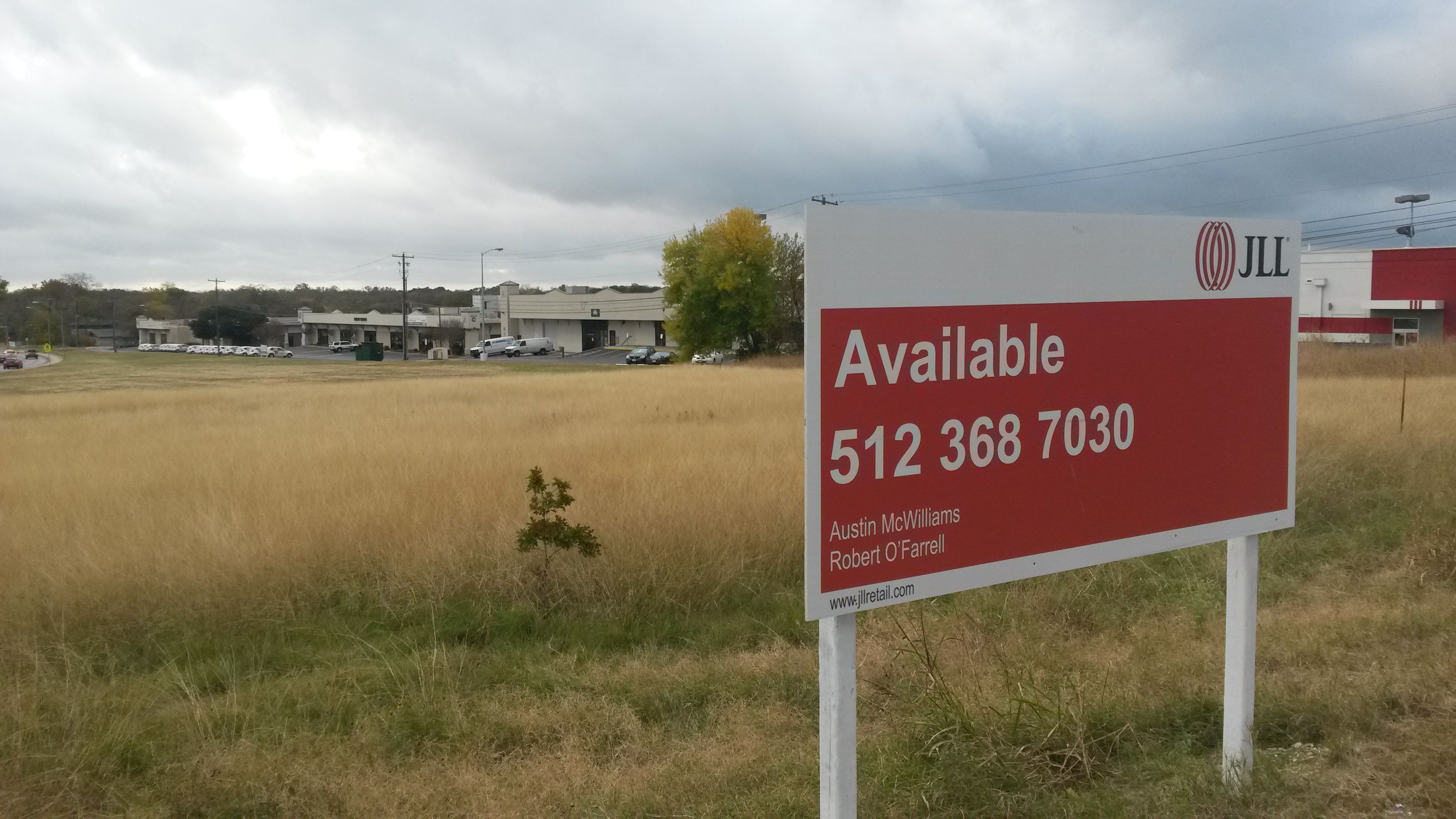
A large plot of vacant land has recently gone on the market at the corner of Koenig and Lamar. The grassy field immediately north of the Goodwill / Half-Price Books parking lot is in a prime location for a large apartment complex. Maybe a mixed-use building with a grocery store in the first floor? Wouldn’t that be nice?
Unfortunately, height restrictions currently make this an unacceptable use of this plot of land. Instead of a 9-story apartment complex with interesting 1st floor amenities that would benefit this neighborhood, this land will be probably be used for a small apartment complex — 4 stories tall — with nothing of interest on the first floor.
This land has potential for some affordable housing options. This land has potential for housing for people who want to use public transportation. But unfortunately, this land also has potential for a Taco Bell. An apartment complex is the most likely development, but height restrictions make fast-food burger-chain development a viable option. (Anybody been to the In-N-Out Burger lately?)
Now don’t get me wrong — height restrictions and compatibility regulations make a lot of sense next to single-family homes, but they don’t make sense in places like the corner of Lamar and Koenig (next door to the Kentucky Fried Chicken).
People in our neighborhood were very successful in battling the “Stealth Dorm” model of development. We very appropriately fought to reduce occupancy limits from 6 unrelated adults on a “single-family” property down to 4 unrelated adults. This drop in allowable occupancy has basically killed the Stealth Dorm. (And long may it stay dead.)
However, that does not help the housing shortage in this town. We have an obligation to find opportunities for people to live in Central Austin. We have said “no” to Stealth Dorms, but we need to say “yes” to a different form of development — something we can live with.
Personally, I think mid-rise housing options along major transit corridors are “low-hanging fruit.” We have thousands of acres of under-utilized land on major bus routes. Surface parking lots and empty fields are the first places we should be looking for urban infill.
I would argue that the Camden Lamar Heights development at the corner of Lamar and North Loop is a much better use of that land than a half-abandoned strip center. Hundreds of people now live next to a bus stop, and that’s good. Soon a few hundred more will live on the other side of Taco Cabana — housing for people instead of a used car lot. Highland Mall will soon be redeveloped, and thousands of people will soon live there, work there, and go to school there.
The opportunities for urban infill development that does not dramatically diminish our quality of life are abundant. And I would say we would be wise to take maximum advantage. Instead of allowing 4 stories next to Goodwill, we should encourage the developer to build 10 stories. They should double the height of development next to Taco Cabana — it wouldn’t hurt anybody. Highland Mall? The sky’s the limit as far as I’m concerned. How would it affect your life to have a 20-story building next to I-35?
Let’s take advantage of opportunities to say “yes” to housing options. Let’s be the progressive neighborhood that understands that people want to live here, and let’s find a way to open the door to new neighbors without destroying what makes this such a desirable neighborhood in the first place.
In the final meeting of the current City Council, Chris Riley wanted to tie up some loose ends before retiring. One big loose end is Airport Boulevard, a project he has worked on for years in efforts to improve a stretch of old highway in the heart of Austin in desperate need of improvement.
Riley identified over $20 million dollars in available funds that he thought could be used to make dramatic improvements to the Airport Boulevard area including pedestrian amenities, turn-lane and intersection improvements. This money had been allocated for urban rail, but since urban rail failed in the ballot initiative in November, this money was available for other projects.
Unfortunately Riley’s proposal met vocal opposition from Kathie Tovo and Laura Morrison who were opposed to providing so much money for Airport Boulevard. In the end, after negotiations, Tovo was willing to support allocation of just 10% of the funds that Riley had identified ($2 million). Morrison was unwilling to support even that.
Ultimately, the allocation of $2 million for Airport Boulevard improvements was supported by all council members except for Morrison who was the only vote against the proposal. The improvements will include adjusting traffic signal timing and alterations to lane striping, but unfortunately we will probably not see much more improvement than that from this initiative. For more substantial improvements, it is likely that a bond will be necessary.




 BalancedReading.org